
GEO for ecommerce is the practice of making your store easy for AI-powered search tools to understand and cite. If you sell products with unfamiliar ingredients, fabrics, or specs, shoppers are not the only audience reading your copy. AI Overviews, chat-based search, and answer engines pull from pages that explain terms clearly and back up claims with real product context. This guide covers what GEO means for Shopify merchants, why glossary definitions matter, and which shortcuts are not worth your time.
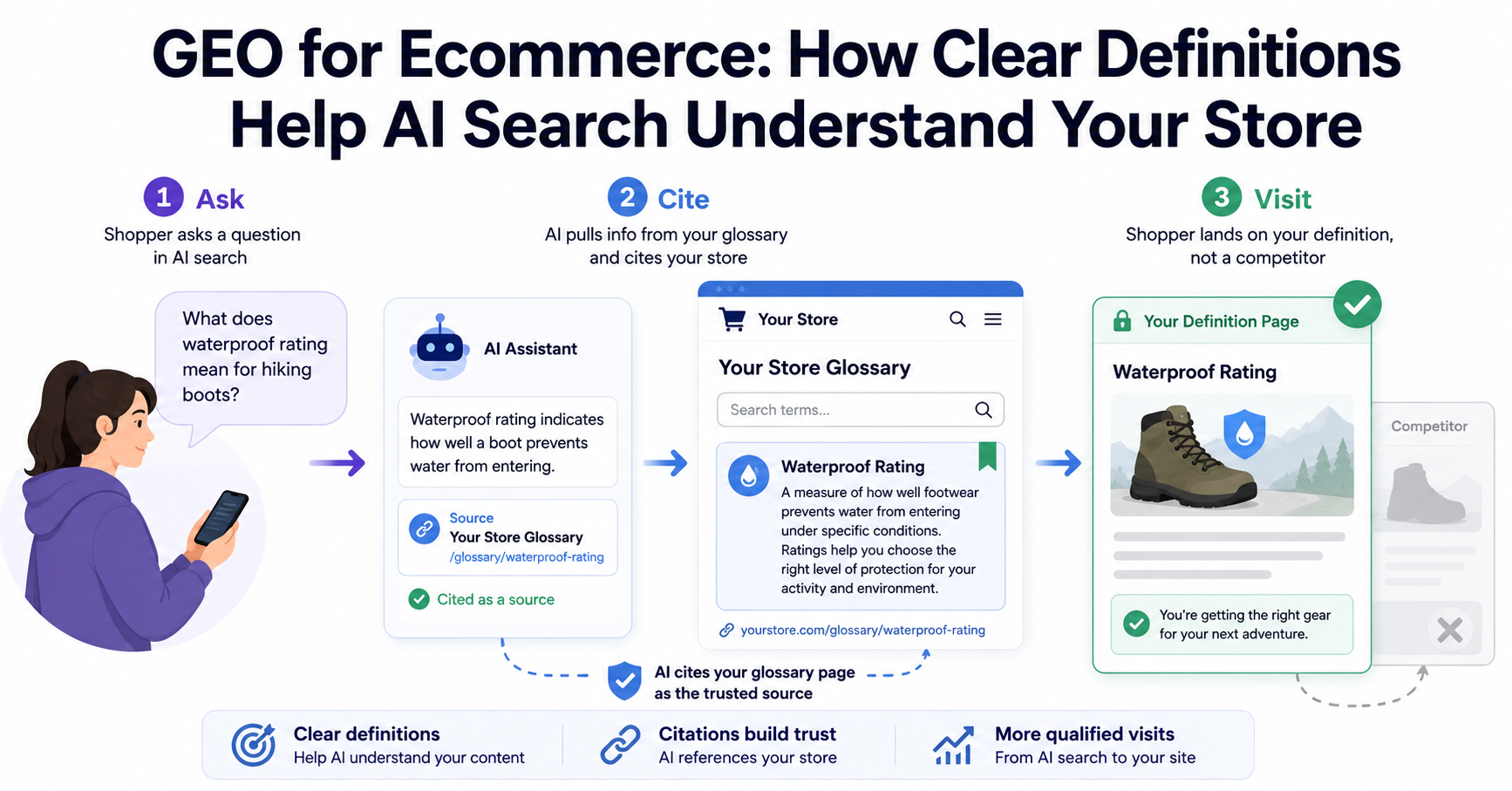
What GEO for ecommerce actually means
GEO stands for generative engine optimization. The phrase sounds new, but the goal is familiar: help search systems understand what your pages are about so they can surface useful answers. For an online store, that usually means product pages, collection pages, blog posts, and glossary term pages that explain the language your catalog uses.
Google has stated that there is no special optimization required for AI Overviews or AI Mode beyond sound SEO fundamentals. The same advice applies to most AI search surfaces: publish accurate, crawlable content written for people first. GEO for ecommerce is less about gaming a new algorithm and more about doing the basics well on pages where product jargon already creates confusion.
Why clear definitions matter to AI search
AI search tools do not read your store the way a human does. They parse text, follow links, and look for passages that directly answer a question. A one-line tooltip might help a shopper in the moment, but a full glossary term page gives an AI system more context: a plain-language definition, an example tied to your products, and links to related terms.
Consider a skincare store selling serums with niacinamide. A shopper might ask an AI tool, “What is niacinamide and is it good for oily skin?” If your store has a dedicated term page with a clear definition, usage notes, and links to relevant products, that page is a stronger candidate for citation than a product description that only lists the ingredient in a bullet point. The definition does the teaching. The product link shows how you apply that knowledge.
This is where a solid glossary term page structure pays off. Pages with a short answer up top, a fuller explanation below, and honest product context give both humans and machines something concrete to work with.
What makes glossary content AI-search ready
GEO for ecommerce works best when your educational content has depth. A 30-word dictionary entry copied from a manufacturer site tells an AI system almost nothing about your expertise. A 200-word definition with your own examples, buyer-relevant caveats, and links to related products tells a different story.
Focus on these practical signals:
- Plain-language definitions – explain the term the way you would to a customer on a support call, not the way a textbook would
- Real examples from your catalog – tie “single origin” to the coffees you roast, or “GSM” to the hoodie weights you sell
- Topical depth across related terms – one definition about “retinol” is useful; a cluster covering retinol, retinoid, and bakuchiol shows range
- First-hand expertise – note how your team tests products, sources materials, or answers common buyer questions
- Updated content – revise definitions when your catalog changes, as you would for any product page
Keeping definitions current is part of the job, not a one-time setup task. A glossary content review process makes sure outdated ingredient claims or discontinued product references do not linger on pages that AI tools might still find.
How GEO for ecommerce connects to standard SEO
Most GEO wins come from the same work that supports traditional search. Dedicated term pages with clean URLs, descriptive titles, and internal links help Googlebot and AI crawlers alike. Glossary SEO for Shopify covers the on-page basics: slugs, meta descriptions, sitemaps, and linking product copy to definitions.
Structured data adds another layer. When your glossary pages use DefinedTerm markup that matches the visible text, you give machines a consistent label for what each page contains. That does not guarantee rich results or AI citations, but it removes ambiguity. Apps like Super Glossary for Shopify can generate that schema and a dedicated sitemap as you publish terms, so you are not hand-coding JSON-LD for every entry.
Google’s guidance on AI features and your website reinforces this point. Focus on helpful, reliable content. Make pages easy to crawl. Do not block resources that affect how your content renders. The fundamentals you already know still apply.
GEO shortcuts that are not worth your time
The hype around GEO for ecommerce has produced plenty of bad advice. Some vendors sell special files, hidden text blocks, or keyword lists designed only for AI crawlers. Others suggest planting fake brand mentions or stuffing pages with phrases you think chatbots prefer. These tactics waste time at best and can damage trust at worst.
Skip approaches like these:
- llms.txt or similar “AI-only” files – there is no widely adopted standard that replaces good on-page content
- Hidden definition blocks – content that shoppers cannot see but crawlers can is a policy risk, not a strategy
- Keyword chunking – repeating the same phrase in unnatural ways does not make your store more quotable
- Fake authority signals – invented citations, exaggerated claims, or copied manufacturer copy add no real expertise
If a tactic only makes sense for a machine and would confuse a human reader, it is probably not worth doing. Write definitions your customers would actually read. Link them from product pages where the terms appear. Let the quality of the content speak for itself.
A practical GEO workflow for your glossary
Start with the terms that cause the most buyer confusion or support tickets. Publish a complete term page for each one, following your standard glossary structure. Link those pages from product descriptions, collection copy, and blog posts using natural anchor text.
Then review quarterly. Check whether definitions still match your current catalog, whether new products introduced terms you have not covered yet, and whether AI search tools are surfacing questions you could answer with a new entry. Track impressions in Search Console for your glossary URLs, but do not expect overnight traffic spikes. GEO for ecommerce is a long game built on clear, maintained definitions – not a single optimization pass.
Shopify App
Ready to turn your store's terminology into an SEO asset? Try Super Glossary for Shopify to automatically link technical terms and add helpful tooltips to your product pages today.